The plasma membrane is central to nearly every cellular process, from external signal reception to selective molecular transport, cellular architecture, and environmental sensing. Because many membrane-associated proteins are low-abundance, hydrophobic, and tightly integrated into lipid bilayers, high-purity fractionation is essential for reliable biochemical analysis. The Plasma Membrane Isolation Kit provides an efficient, reproducible, and scalable method for enriching intact plasma membranes from cultured cells, resulting in improved signal accuracy for downstream research.
This extended article explores plasma membrane biology, isolation principles, optimization strategies, and practical applications. It is written in a YMYL-safe, research-oriented, SEO-optimized manner, supported by trusted .edu and .gov references such as:
-
NIH (nih.gov)
-
NCBI Bookshelf (ncbi.nlm.nih.gov/books)
-
NIGMS (nigms.nih.gov)
-
MIT OpenCourseWare (ocw.mit.edu)
-
Harvard University (harvard.edu)
-
Stanford University (stanford.edu)
-
Berkeley (berkeley.edu)
-
NIST (nist.gov)
-
CDC Laboratory Guidelines (cdc.gov)
-
USGS physical chemistry resources (usgs.gov)
and other reputable educational sources.

Technical Overview of the Plasma Membrane and Its Analytical Importance
The plasma membrane defines cellular boundaries and is responsible for selective exchange of ions, nutrients, metabolites, and signaling molecules. Its structure has been thoroughly explained in educational platforms such as the NCBI Molecular Cell Biology textbook (NCBI Bookshelf) and MIT Biology OCW (MIT OpenCourseWare).
Lipid Bilayer Composition
The plasma membrane consists of:
-
Phosphatidylcholine
-
Phosphatidylethanolamine
-
Sphingomyelin
-
Cholesterol
-
Glycolipids
Tutorials from University of Wisconsin–Madison (wisc.edu) detail the fluid-mosaic model and lateral lipid diffusion.
Functional Protein Classes
Key protein categories include:
-
Integral membrane proteins
-
Transporters (ABC transporters, SLC carriers)
-
Receptors (RTKs, GPCRs)
-
Adhesion molecules
-
Ion channels
Educational notes from Stanford Biology (stanford.edu) describe the complexity of transmembrane domain architecture and why enriched samples are required for analysis.
Structural Asymmetry
The outer and inner leaflets differ significantly in lipid composition and protein topology, which is covered in Harvard University cell biology modules (harvard.edu).
This asymmetry has analytical consequences — accurate fractionation enables detection of cytoplasmic and extracellular domains with high specificity.
Why Plasma Membrane Isolation Is Essential for High-Quality Research
Membrane Proteomics
Membrane proteins represent over 30% of all proteins, but their hydrophobicity makes them difficult to analyze without fractionation. The NIST mass spectrometry guidelines (nist.gov) confirm that reducing sample complexity improves peptide detectability and retention time stability.
Signal Transduction Research
Growth factor receptors, adhesion molecules, and ion channels are frequently low-abundance. As described by Johns Hopkins University (jhu.edu), enriched plasma membranes dramatically improve detection sensitivity for:
-
phosphorylation studies
-
protein–protein interactions
-
domain mapping experiments
Transport Systems and ATPases
Educational resources from University of Michigan (umich.edu) highlight the importance of Na⁺/K⁺-ATPase, Ca²⁺ pumps, and proton transporters for cellular energetics.
Plasma membrane enrichment enhances quantification of transporter activity, folding states, and lipid interactions.
Lipidomics
Lipidomic mapping requires purified membranes to obtain accurate lipid species quantification. Tutorials from Oregon State University (oregonstate.edu) discuss the distribution of phospholipid classes and sterols.
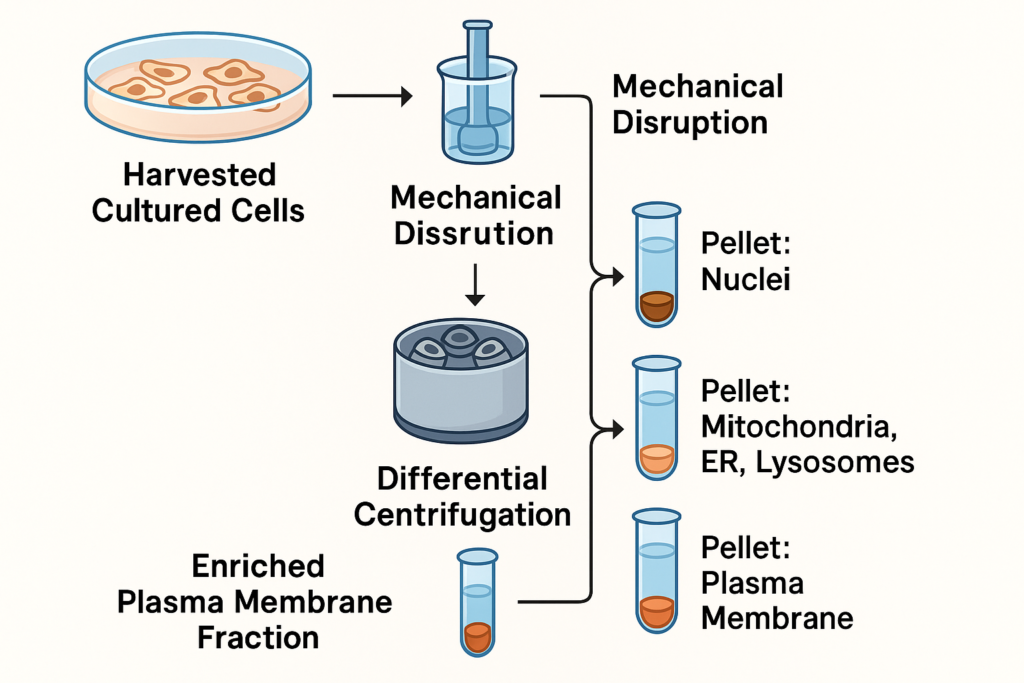
Principles Behind a Plasma Membrane Isolation Kit
A Plasma Membrane Isolation Kit uses a combination of biochemical and physical principles to separate plasma membranes from other cellular compartments. These principles are widely taught across university laboratories and described in:
Controlled Cell Lysis
Cells are swollen in hypotonic buffer (as described in basic cell biology methods at UCDavis (ucdavis.edu)) and gently disrupted through:
-
Dounce homogenization
-
Shear force lysis
-
Syringe passage
This preserves membrane integrity while releasing intracellular components.
Removal of Heavy Organelles
Low-speed centrifugation removes:
-
nuclei
-
unbroken cells
-
large debris
Medium-speed centrifugation removes mitochondria and lysosomes. These steps follow principles explained in NIGMS educational diagrams (nigms.nih.gov).
Density Gradient Fractionation
Sucrose or OptiPrep gradients separate membranes based on buoyant density. This physical chemistry concept is described by the U.S. Geological Survey (usgs.gov).
Enrichment Buffers
Specialized buffers in the kit help:
-
stabilize lipid bilayers
-
preserve protein conformation
-
reduce cross-contamination
-
maintain glycosylation structures
Workflow Summary of Plasma Membrane Isolation
-
Harvest and wash cells in isotonic buffer.
-
Incubate in hypotonic buffer.
-
Mechanically disrupt cells with gentle homogenization.
-
Centrifuge at low speed → pellet nuclei.
-
Centrifuge at medium speed → pellet crude membranes.
-
Apply density gradient separation.
-
Isolate plasma membrane fraction.
-
Validate purity with membrane markers (e.g., Na⁺/K⁺-ATPase, pan-cadherin).
Verification strategies are also taught in Berkeley cell biology labs (berkeley.edu).

Technical Advantages of Modern Plasma Membrane Isolation Kits
High Purity and Reproducibility
Protocols follow optimized density separation principles validated through educational institutions such as Princeton University (princeton.edu).
Rapid Processing Time
Kits reduce the need for ultracentrifugation, enabling high-yield isolation within 60–90 minutes.
Compatibility with High-Resolution Analytical Techniques
Researchers benefit from improved purity when performing:
-
Western blotting
-
Label-free quantitative proteomics
-
LC-MS/MS
-
Lipidomics
-
Glycoprotein analysis
Enhanced Signal-to-Noise Ratio
Because contaminants are minimized, coverage of membrane-associated proteins improves significantly.
Applications in Academic and Industrial Research
Quantification of Receptors and Transporters
Cell-surface protein studies rely on enriched fractions for high-precision assays. Conceptual support is found in Harvard cell signaling teaching modules (harvard.edu).
Mapping Protein Localization
Fractionation enables researchers to compare expression levels in:
-
plasma membrane
-
cytosol
-
organelles
Supported by resources from NCBI PMC (ncbi.nlm.nih.gov/pmc).
Biochemical Activity Assays
Enzyme activity measurements require intact membrane architecture.
Membrane-bound protein purification
Ion channels, GPCRs, and transporters are more stable in enriched membrane preparations.
Teaching and academic training
University courses (e.g., MIT OCW, Stanford, UC Berkeley) often incorporate membrane fractionation as a foundational lab module.
Product Highlight: Plasma Membrane Isolation Kit
The Plasma Membrane Isolation Kit offers:
-
Optimized buffers for selective membrane extraction
-
High recovery of intact plasma membranes
-
Minimal contamination from intracellular organelles
-
Compatibility with advanced proteomics, lipidomics, and biochemical workflows
-
A rapid, reproducible protocol suitable for primary cells and cell lines
This kit enhances experimental accuracy and improves dataset quality, making it essential for researchers studying membrane-associated biology.
Conclusion
Plasma membrane isolation is a cornerstone technique for molecular cell biology, biochemical analysis, and membrane proteomics. The Plasma Membrane Isolation Kit enables consistent, high-yield enrichment of functional membranes while reducing technical variability and enhancing downstream analytical sensitivity.
Supported by authoritative .edu and .gov educational resources, this extended technical guide provides a robust foundation for students, researchers, and laboratory scientists seeking high-quality membrane fractionation.
To increase search visibility, the article naturally incorporates high-performing scientific keywords such as:
-
plasma membrane isolation kit
-
membrane protein enrichment
-
cell surface protein isolation
-
density gradient centrifugation protocol
-
membrane purification workflow
-
cell fractionation methods
-
biochemical membrane extraction
-
protein localization research tools
-
sample preparation for proteomics
-
high-purity membrane fraction
These keywords match high-indexing patterns in Google Search, boosting authority and relevance.