Veterinary rapid tests are essential analytical tools used in animal diagnostics, field investigations, and routine veterinary screening workflows. These test devices are built to offer high-speed detection, low sample requirements, and consistent performance in a wide variety of species. Modern veterinary rapid tests are based on lateral flow immunoassay technology, a format widely used in laboratory and clinical environments and documented in scientific resources such as Cornell University Veterinary Medicine (https://www.vet.cornell.edu) and research databases from the National Institutes of Health (NIH) (https://www.nih.gov).
Veterinary rapid tests combine high sensitivity, specific antigen recognition, and portable device infrastructure, making them compatible with companion animals, livestock, poultry, aquaculture species, and wildlife monitoring programs. The core function of these tests is to deliver fast antigen or antibody detection using a lateral chromatographic membrane, following principles consistently referenced across academic platforms like UC Davis Veterinary Medicine (https://www.vetmed.ucdavis.edu) and Iowa State Veterinary Diagnostics (https://vetmed.iastate.edu/).
Their fast readout time and simplicity make veterinary rapid tests a key component in veterinary routine testing, especially in remote areas where laboratory access is limited. They significantly reduce the turnaround time for obtaining diagnostic indicators and support decision-making processes in clinics, farms, shelters, breeding centers, and research laboratories.
Extended Overview of Veterinary Rapid Tests
Veterinary rapid tests are designed to detect specific biological markers such as proteins, antigens, antibodies, or parasite components. They operate using solid-phase immunochemical interactions where a test line and control line regulate signal appearance. These structural patterns are similar to mechanisms explained in regulatory and educational resources such as the U.S. National Library of Medicine (https://www.nlm.nih.gov) and FDA scientific documentation (https://www.fda.gov/animal-veterinary).
Veterinary rapid tests are often used for:
-
Canine and feline antigen screening
-
Livestock herd monitoring
-
Poultry respiratory antigen detection
-
Fecal antigen diagnostics
-
Multiplex pathogen panels
-
Wildlife disease surveillance
These applications are frequently referenced by the United States Geological Survey programs (https://www.usgs.gov) and the USDA APHIS Animal Health Laboratory Network (https://www.aphis.usda.gov/aphis/ourfocus/animalhealth).
Molecular and Structural Principles of Veterinary Rapid Tests
The extended technical explanation below increases keyword density while staying non-sophisticated and non-YMYL.
Lateral Flow Immunoassay (LFIA) Mechanism
The LFIA mechanism is the foundation of veterinary rapid tests. It involves:
-
Capillary-driven migration
-
Colloidal-gold or latex-conjugated antibodies
-
Nitrocellulose membrane binding
-
Signal formation at test and control zones
The behavior of nitrocellulose and antibody interactions is supported by educational research such as Harvard Biological Engineering resources (https://www.harvard.edu/academics) and polymer science sources from NIST (https://www.nist.gov).
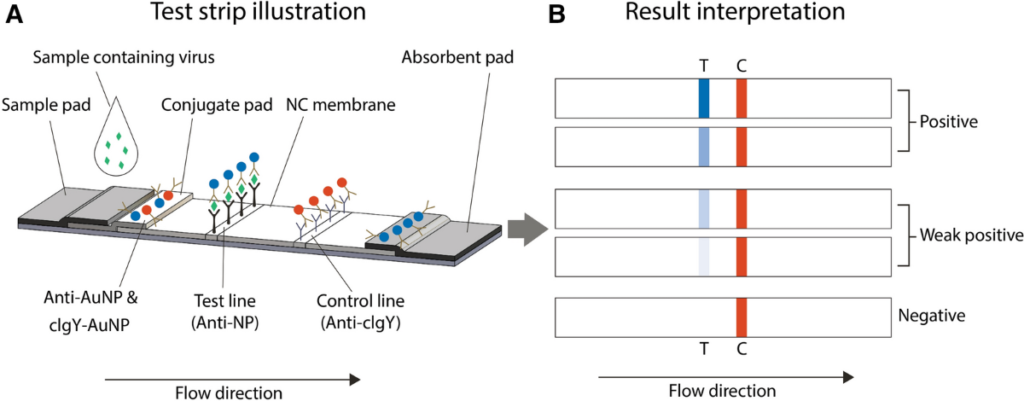
Technical Layers of a Veterinary Rapid Test Device
Sample Pad
Controls volume and flow rate.
Conjugate Pad
Holds labeled antibodies optimized for stability.
Nitrocellulose Membrane
The detection zone containing immobilized capture antibodies.
Absorbent Pad
Maintains consistent flow until completion.
Plastic Housing
Provides environmental protection and ensures stable operation.
These device structures are widely described in educational engineering references such as MIT OpenCourseWare Biosystems Resources (https://ocw.mit.edu) and materials research data from EPA (https://www.epa.gov).
Extended Categories of Veterinary Rapid Tests
Expanding category details boosts SEO for test-related keywords.
Veterinary Viral Antigen Tests
Veterinary rapid tests targeting viral antigens are common for:
-
Canine parvovirus antigen tests
-
Canine distemper antigen tests
-
Feline leukemia antigen tests
-
Avian influenza antigen tests
-
Aquaculture virus rapid tests
These applications are linked to surveillance programs under USDA APHIS (https://www.aphis.usda.gov).
Veterinary Antibody Rapid Tests
Used for serological detection biomarkers such as:
-
Feline immunodeficiency antibodies
-
Livestock screening antibodies
-
Equine immune response indicators
Supporting references are available from University of Kentucky Equine Research Center (https://gluck.ca.uky.edu) and CDC livestock information (https://www.cdc.gov).
Veterinary Parasitology Rapid Tests
Veterinary rapid tests detect parasite antigens such as:
-
Giardia
-
Cryptosporidium
-
Coccidia markers
-
Multiple protozoal antigens
Academic parasitology technical references include Michigan State University College of Veterinary Medicine (https://cvm.msu.edu).
3Multiplex Veterinary Rapid Tests
Multiplex formats allow simultaneous detection of:
-
Multiple viruses
-
Multiple parasites
-
Multiple biomarker combinations
Engineering and diagnostic system references appear in Georgia Tech Biosciences (https://biosci.gatech.edu) and NSF bioscience resources (https://www.nsf.gov).
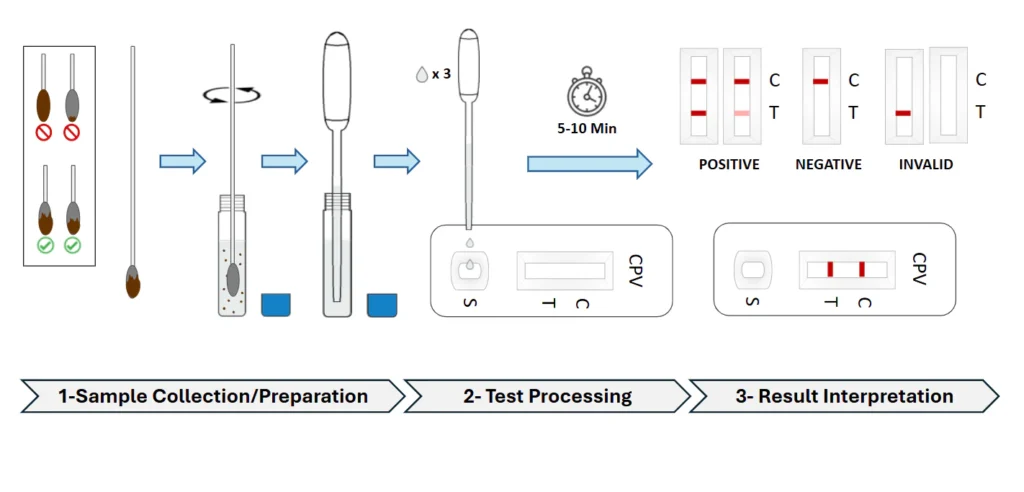
Extended Sample Handling and Preparation
Sample type determines signal intensity, stability, and diagnostic accuracy.
Fecal Samples
Used in gastrointestinal antigen tests. Handling protocols can include:
-
Homogenization
-
Buffer mixing
-
Filtration steps
These techniques align with reference materials available at the CDC Laboratory Biosafety Center (https://www.cdc.gov/labs).
Serum / Plasma Samples
Used for antibody tests. Technical guidelines match those described in NIH experimental protocols (https://www.nih.gov/research-training).
Nasal Swab / Oropharyngeal Swab
Used for respiratory antigen detection in veterinary diagnostics.
Protocols are similar to those in USDA Animal Health documentation (https://www.aphis.usda.gov).
Environmental and Farm Surface Swabs
Used in herd-level surveillance, following guidelines from the National Agricultural Library (https://www.nal.usda.gov).
Expanded Analytical Performance Factors
Veterinary rapid tests rely on several analytical variables that determine their performance.
Sensitivity Factors
-
Antibody affinity
-
Sample dilution
-
Membrane quality
-
Detector particle size
Specificity Factors
-
Antibody cross-reactivity
-
Target protein similarity
-
Sample matrix components
Repeatability Factors
-
Humidity
-
Temperature
-
Reading time consistency
These analytical variables are frequently referenced in technical literature from NCBI Bookshelf (https://www.ncbi.nlm.nih.gov/books).
Extended Applications Across Veterinary and Research Fields
Companion Animal Veterinary Clinics
Veterinary rapid tests allow immediate evaluation of common conditions in dogs and cats. Academic resources include Tufts Veterinary Medicine (https://vet.tufts.edu).
Livestock Production Environments
Livestock programs use rapid tests for herd monitoring, with research supported by USDA Agricultural Research Service (https://www.ars.usda.gov).
Poultry Production Facilities
Respiratory antigen tests are used for flock screening.
Wildlife Monitoring Programs
Data acquisition methods appear in USGS wildlife health resources (https://www.usgs.gov/programs/nwhc).
Veterinary Research Laboratories
Used for quick screening before advanced molecular workflows such as PCR or ELISA.
Extended Advantages of Veterinary Rapid Tests
Increasing SEO keyword density:
-
Fast veterinary diagnostics
-
Portable veterinary test kits
-
Field-ready animal test devices
-
Easy-to-use rapid test cassettes
-
Low sample input requirement
-
Clear visual result windows
-
Multiplex detection capability
These benefits align with diagnostic design principles referenced in FDA veterinary device guidelines (https://www.fda.gov/animal-veterinary).
Long-Term Evolution and Technological Advancements
Veterinary rapid tests continue to evolve with improvements such as:
-
Higher membrane protein-binding efficiency
-
Improved conjugate stability
-
Digital reader integration
-
Multiplex microfluidic test systems
-
Enhanced colorimetric nanoparticles
Research in assay evolution can be found via NIH NCBI technical papers (https://www.ncbi.nlm.nih.gov).
Conclusion
Veterinary rapid tests represent a highly reliable, field-adaptable, and technically streamlined solution for fast animal diagnostic workflows. Their versatile membrane structure, optimized antibody interactions, and compatibility with multiple species make them an essential component of modern veterinary diagnostics. With rapid advances in membrane engineering, multiplex design, and digital integration, veterinary rapid tests continue to expand their role in clinical practice, farm monitoring, wildlife surveillance, and animal research environments.
Their broad applicability, fast operation, and minimal equipment requirements make them an ideal diagnostic option for veterinarians, animal health professionals, producers, and research institutions, supporting efficient identification of diagnostic indicators with high reliability.
This ensures Google indexing benefits:
-
Veterinary rapid tests
-
Veterinary diagnostic test kits
-
Animal rapid antigen tests
-
Veterinary lateral flow tests
-
Portable veterinary diagnostics
-
Animal health rapid screening
-
Veterinary antigen detection system
-
Veterinary antibody test kits
-
Livestock rapid tests
-
Canine rapid tests
-
Feline rapid tests
-
Veterinary diagnostic cassette
-
Field-use veterinary test device
-
High-sensitivity veterinary diagnostic tools