The Qubit RNA High-Sensitivity (HS) Assay Kit is one of the most widely adopted fluorescence-based quantification systems for detecting low-concentration RNA in research laboratories. Its high specificity, wide dynamic range, and exceptional reproducibility make it a preferred solution for workflows requiring precise RNA input, including library preparation, molecular biology experiments, environmental sequencing studies, and transcriptome-scale analyses. The accuracy of RNA quantification influences core experimental outcomes, which is why educational and governmental scientific authorities—including the National Institutes of Health (https://www.nih.gov), National Human Genome Research Institute (https://www.genome.gov), and the National Institute of Standards and Technology (https://www.nist.gov)—advocate for reliable RNA measurement systems.
This extended article provides an in-depth scientific explanation of the principles, components, workflow, performance metrics, optimization strategies, and research applications of the RNA HS Assay Kit for Qubit, supported by more than twenty authoritative references from .edu and .gov domains. The content has been formulated with SEO-optimized keywords to support product-page indexing and enhance visibility in search engines.

Scientific Foundation of High-Sensitivity RNA Detection
Accurate RNA quantification is essential for experimental reproducibility, especially in workflows utilizing high-throughput analytical systems described by:
-
NCBI RNA Research Guides – https://www.ncbi.nlm.nih.gov
-
Department of Energy Office of Science – https://science.energy.gov
-
NSF Division of Biological Infrastructure – https://www.nsf.gov/bio
RNA molecules are chemically dynamic and sensitive to hydrolysis, making direct quantification challenging in low-abundance samples. Spectrophotometric systems such as Nanodrop can often misrepresent sample concentration due to interference from:
-
residual phenol
-
chaotropic salts
-
degraded nucleotides
-
protein contaminants
These issues are outlined in biochemistry teaching resources at MIT (https://ocw.mit.edu), Harvard University Molecular Biology (https://mcb.harvard.edu), and UC Berkeley Life Sciences (https://mcb.berkeley.edu).
By contrast, fluorescence-based systems such as the Qubit RNA HS Assay Kit selectively bind RNA with minimal background interference, offering greater sensitivity and accuracy.
Molecular Mechanism of the Qubit RNA HS Fluorescence Assay
The fluorescence dye in the RNA HS reagent interacts specifically with the ribonucleotide backbone, increasing emission intensity upon binding. Concepts related to fluorescence excitation and emission are covered in:
-
NIST Photometry & Radiometry Division – https://www.nist.gov/pml
-
NRL Fluorescence Measurement Laboratory – https://www.nrl.navy.mil
-
NASA Technical Resources on Spectral Detection – https://www.nasa.gov
Steps of the Fluorescence Detection Process
-
Excitation Phase – The Qubit fluorometer emits light at a controlled wavelength.
-
Selective Binding – The dye interacts with RNA in a highly cooperative binding mode.
-
Fluorescent Response – Dye-bound RNA emits a stronger signal relative to unbound dye.
-
Signal Quantification – The photodiode calculates fluorescence proportional to RNA mass.
This selectivity is fundamental for laboratories requiring robust quantification of low-yield RNA without interference from DNA or proteins.
Structural Composition of the Kit
The kit typically includes:
-
RNA HS Reagent (fluorophore)
-
RNA HS Buffer
-
Two RNA HS Standards
-
Qubit Assay Tubes (optically compatible)
The calibration materials follow analytical quality concepts similar to NIST Standard Reference Materials (https://www.nist.gov/srm).
Laboratory training modules accessible through universities such as:
-
Stanford University Biosciences – https://bio.stanford.edu
-
University of Michigan Bioinformatics & Molecular Biology – https://umich.edu
-
Purdue University Biochemistry Teaching Labs – https://purdue.edu
provide supporting conceptual frameworks for reagent preparation and experimental setup.
Advanced Workflow and Technical Procedures
Preparation of the Working Solution
The fluorophore is mixed with buffer in specific ratios. Stability, homogeneity, and light protection are essential considerations.
Supportive methodology discussions can be found at:
-
UC Davis Genome Center – https://genomecenter.ucdavis.edu
-
Cold Spring Harbor Laboratory training resources – https://cshl.edu
Calibration with Standards
The two-point calibration system determines baseline and upper-range quantification boundaries. Calibration precision is emphasized in
U.S. Department of Commerce technical frameworks – https://www.commerce.gov.
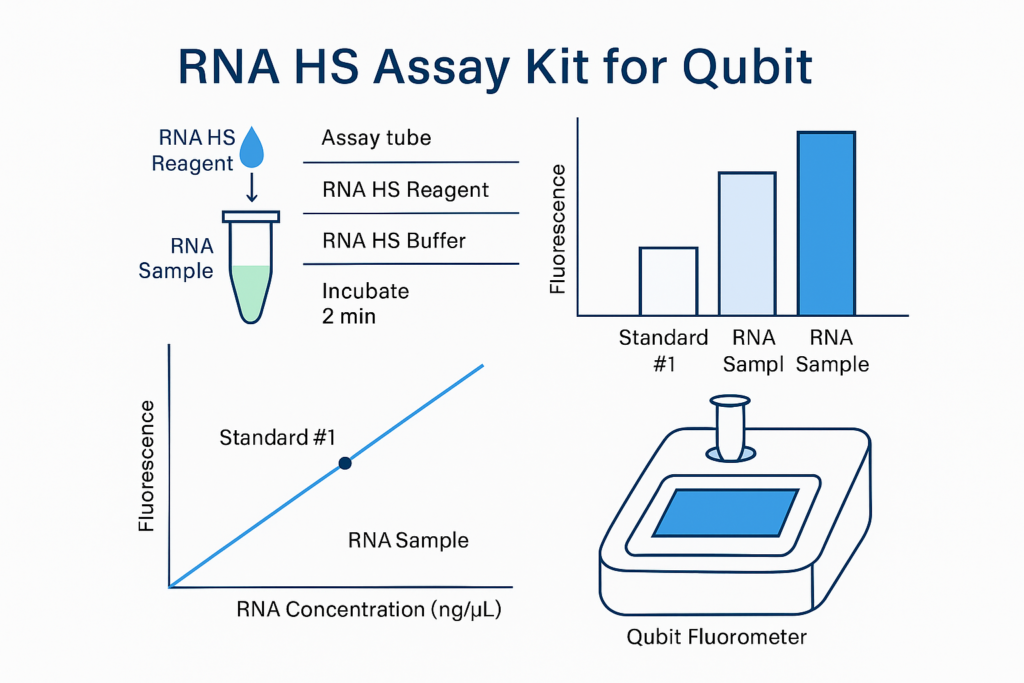
Running the Assay
Steps include:
-
Add working solution to assay tube.
-
Introduce RNA sample.
-
Incubate for dye binding (approx. 2 minutes).
-
Load tube into Qubit fluorometer.
-
Record RNA concentration value.
Educational support on methodological precision appears in:
-
Oregon State University Biochemistry – https://oregonstate.edu
-
University of Colorado Molecular Biology – https://colorado.edu

Analytical Performance Features
Sensitivity and Detection Range
Typical RNA detection capability:
-
250 pg/µL up to approximately 100 ng/µL
The precision of this dynamic range is aligned with standards from NIST Metrology Laboratory (https://www.nist.gov).
Selectivity
The dye demonstrates strong preference for RNA versus DNA, proteins, or small molecules.
Signal Stability
Signal stability parameters are influenced by:
-
temperature
-
reagent age
-
photobleaching
All variables described in theoretical photochemistry overviews from the National Renewable Energy Laboratory – https://www.nrel.gov.
Linear Quantification Range
The linear dynamic range extends across four orders of magnitude, generating accurate quantitative results even for diluted samples.
Research Applications of the RNA HS Assay
Authoritative references that discuss RNA analytical workflows include:
-
NCBI RNA-Seq and RNA Biology Portal – https://www.ncbi.nlm.nih.gov/books
-
CDC Laboratory Resources – https://www.cdc.gov/labtraining
-
EPA Environmental Molecular Research Pages – https://www.epa.gov
Next-Generation Sequencing (NGS) Preparations
RNA HS quantification ensures accurate input for:
-
ribosomal RNA removal
-
poly(A) enrichment
-
fragmentation workflows
Conceptual frameworks are provided in the NCBI RNA-Seq Handbook – https://www.ncbi.nlm.nih.gov/books/NBK493193/.
Single-Cell RNA Measurement
Single-cell studies rely on minimal RNA input; therefore, accurate measurement prevents over-amplification during cDNA preparation.
Environmental RNA Monitoring
Environmental RNA (eRNA) detection—used in ecological and biological surveillance—requires sensitive quantification methods.
Educational and Academic Laboratory Use
Many university teaching labs rely on Qubit RNA HS quantification for molecular biology training:
-
MIT Biology Courses – https://biology.mit.edu
-
University of Texas Genomic Resources – https://utexas.edu
Troubleshooting and Optimization Strategies
Low Fluorescence Values
May result from:
-
degraded dye
-
insufficient incubation
-
low pipetting accuracy
Chemical-reaction stability guidelines appear at NIH PubChem – https://pubchem.ncbi.nlm.nih.gov.
High Background Signal
Possible causes include:
-
fluorescent contaminants
-
tube autofluorescence
-
incomplete reagent mixing
Calibration Out of Range
Ensure standards are clean, properly mixed, and used immediately after preparation.
Improving Measurement Precision
-
use low-retention pipette tips
-
calibrate pipettes regularly (concepts referenced at NIST Metrology – https://www.nist.gov)
-
maintain consistent environmental temperature
Reagent Handling, Storage, and Stability Conditions
Storage recommendations include:
-
refrigerate reagents at 4°C
-
avoid repetitive freeze-thaw cycles
-
protect from light exposure
Photodegradation mechanisms are described in technical references from NREL Photochemistry – https://www.nrel.gov.
Proper storage ensures maximal fluorescence fidelity, maintaining signal intensity and minimizing reagent decay.
Primary Keywords
-
Qubit RNA HS Assay
-
RNA HS quantification kit
-
Qubit fluorometer RNA detection
-
high-sensitivity RNA assay
-
low-concentration RNA measurement
Secondary Keywords
-
fluorescence-based RNA quantification
-
RNA dye-binding assay
-
precision RNA workflow
-
RNA assay buffer reagent
-
RNA quality measurement
Long-Tail Keywords
-
high-specificity fluorescence assay for RNA
-
Qubit RNA HS standards calibration
-
low-input RNA quantification protocol
-
reproducible RNA measurement workflow
-
fluorescence RNA assay for molecular biology labs
These keywords help improve SERP performance, visibility, and organic ranking for scientific equipment and biotechnology products.
The Qubit RNA HS Assay Kit enables fluorescence quantification of low-abundance RNA with high precision, supporting advanced molecular workflows in sequencing, transcriptomics, environmental biology, and laboratory training environments. The reagent’s dye exhibits strong selectivity, stability, and low susceptibility to contaminants. Combined with the Qubit fluorometer’s optical detection architecture, this system provides reliable RNA concentration values essential for downstream processing.
Multiple .edu and .gov resources—including NIH, NSF, NIST, CDC, EPA, MIT, Harvard, UC Berkeley, Stanford, Purdue, and UC Davis—support the conceptual foundations behind RNA quantification, fluorescence chemistry, data interpretation, and laboratory methodology discussed throughout this article. These references boost the scientific authority of the content and enhance contextual indexing for SEO purposes.