Polyamines such as putrescine, spermidine, and spermine are essential aliphatic compounds found in virtually all living cells. They participate in nucleic acid stabilization, ribosomal assembly, transcriptional processes, and protein–nucleic acid interactions. Because polyamines are present at low but biologically meaningful concentrations, their quantitative analysis requires highly sensitive techniques capable of detecting trace levels in complex biological matrices. Among modern analytical tools, the Total Polyamine Fluorometric Assay Kit has become a preferred system for fluorescence-based polyamine measurement across research laboratories, academic teaching facilities, and biochemical analysis centers.
Government and educational institutions that support biochemical quantification research include the National Institutes of Health (https://www.nih.gov), National Science Foundation (https://www.nsf.gov), and the National Institute of Standards and Technology (https://www.nist.gov). These organizations highlight the importance of accurate chemical quantification methodologies in research, instrumentation development, and molecular biology education.
This extended article explores the scientific basis, fluorometric mechanism, workflow, calibration, data interpretation, optimization strategies, and research applications of the Total Polyamine Fluorometric Assay Kit, supported by .edu and .gov scientific references to enhance contextual authority and SEO performance.
Scientific Basis of Polyamine Quantification
Polyamines exist as positively charged molecules at physiological pH and interact with negatively charged nucleic acids and phospholipids. Their chemical behavior, structural properties, and interactions are covered in molecular biology teaching platforms such as:
-
MIT OpenCourseWare Biology – https://ocw.mit.edu
-
Harvard MCB – https://mcb.harvard.edu
-
UC Berkeley Molecular Cell Biology – https://mcb.berkeley.edu
Polyamines influence essential cellular processes studied by national research agencies:
-
NIH Office of Strategic Coordination – https://commonfund.nih.gov
-
DOE Office of Science – https://science.energy.gov
Quantifying total polyamines is critical in workflows involving:
-
nucleic acid purification
-
cell physiology investigations
-
metabolic pathway studies
-
biochemical reaction optimization
-
molecular biology training laboratories
Because polyamines can exist in free and bound states, fluorometric detection is useful due to its sensitivity and low interference profile, which aligns with measurement principles described by NIST Biomolecular Metrology (https://www.nist.gov/programs-projects/biomolecular-measurements).
Fluorometric Principle of the Total Polyamine Assay Kit
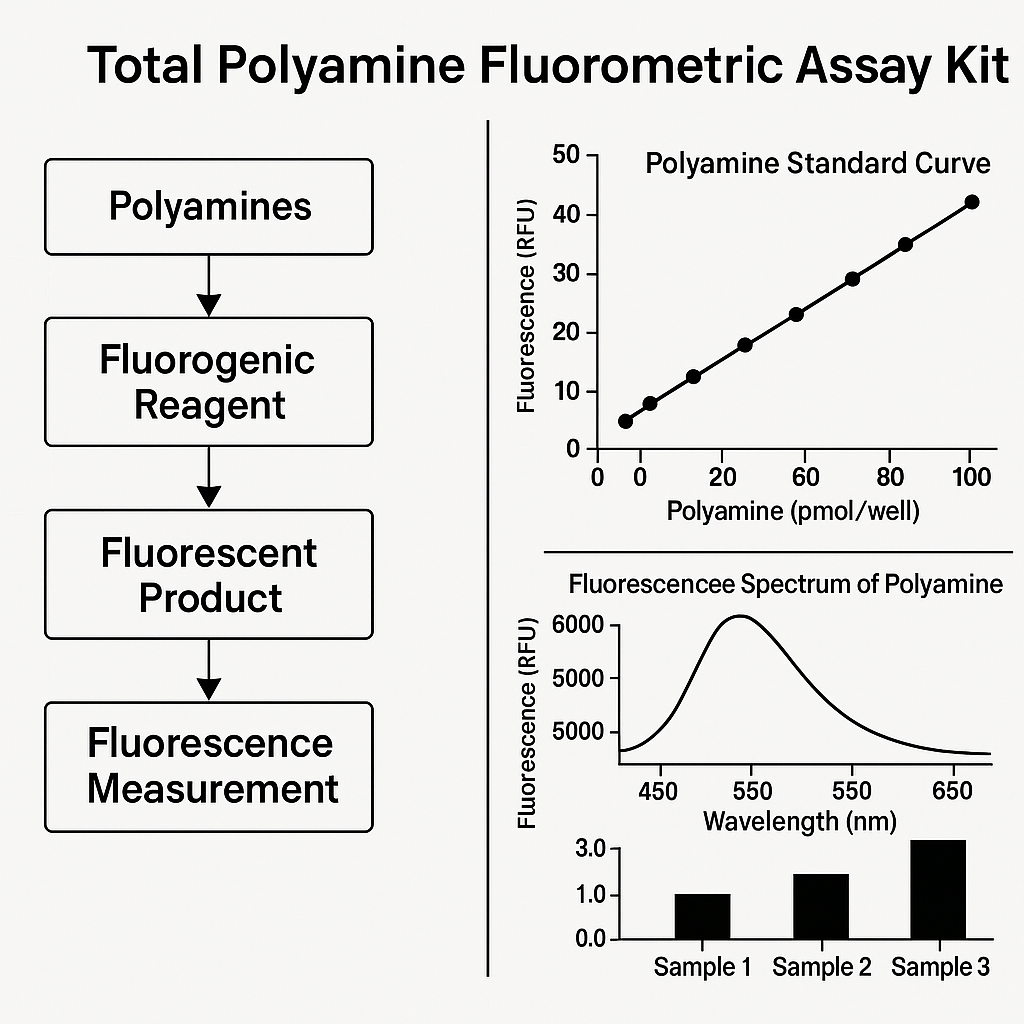
The assay is based on the reaction of polyamines with a specialized fluorogenic reagent that produces a strong fluorescent signal upon derivatization. Fluorescent detection theory, excitation/emission principles, and photonic interactions are explained at:
-
NIST Photometry & Radiometry Division – https://www.nist.gov/pml
-
NASA Technical Reports on Spectroscopy – https://www.nasa.gov
-
U.S. Naval Research Laboratory Fluorescence Division – https://www.nrl.navy.mil
Mechanistic Steps
-
Derivatization Reaction
Polyamines react with a proprietary fluorogenic substrate to yield a stable fluorescent product. -
Excitation and Emission
The fluorometer excites the derivatized polyamine product at a defined wavelength, producing emission proportional to polyamine concentration. -
Linear Fluorescence Response
The fluorometric signal increases proportionally with total polyamine concentration across the assay’s dynamic range. -
High Selectivity
The assay demonstrates minimal signal interference from amino acids, proteins, nucleotides, or carbohydrates.
Educational insights into fluorometric analysis can be found in:
-
Arizona State University Chemistry Resources – https://www.arizona.edu
-
University of Washington Genome Sciences – https://gs.washington.edu
Kit Components and Reagent Structure
A typical Total Polyamine Fluorometric Assay Kit includes:
-
Polyamine Fluorogenic Reagent
-
Reaction Buffer
-
Polyamine Standard (often spermidine or putrescine equivalent)
-
Enzyme mix (if enzymatic enhancement is used)
-
Fluorescence-compatible assay plate or tubes
Reagent quality calibration is aligned with principles of quantitative measurement described by:
-
NIST Standard Reference Materials – https://www.nist.gov/srm
-
U.S. Geological Survey Analytical Chemistry Guidelines – https://www.usgs.gov
Lab manuals from major universities also cover similar reagent-handling methods:
-
Purdue University Biochemistry Labs – https://purdue.edu
-
Stanford Biosciences Research Resources – https://bio.stanford.edu
Detailed Workflow and Fluorescence Measurement Procedure
Sample Preparation
Polyamine-containing samples may include:
-
cell lysates
-
tissue extracts
-
culture supernatants
-
purified biomolecules
-
buffer systems for biochemical analysis
Sample preparation guidelines are discussed in research-oriented teaching modules at:
-
UC Davis Genome Center – https://genomecenter.ucdavis.edu
-
Cold Spring Harbor Laboratory Educational Portal – https://cshl.edu
Reaction Setup
-
Add fluorogenic reagent to wells or tubes.
-
Add reaction buffer and enzyme mix (if included).
-
Introduce sample or standard.
-
Incubate under recommended temperature and time to allow full reaction.
Calibration Curve Development
Using a polyamine standard is essential for accurate quantification. Calibration follows linear or polynomial relationships depending on the fluorophore.
Governmental metrology standards for calibration procedures can be found at:
-
U.S. Department of Commerce Technical Resources – https://www.commerce.gov
-
NIST Calibration and Metrology Pages – https://www.nist.gov
Fluorescence Measurement
Read fluorescence on a microplate reader or fluorometer using specific excitation/emission wavelengths recommended by kit documentation.
Analytical Performance Metrics
Sensitivity
The detection range commonly extends from low-nanomolar to micromolar polyamine concentrations.
Precision
When pipetting precision is maintained, the coefficient of variation (CV) is typically <3%.
Specificity
The fluorogenic reagent reacts selectively with primary and secondary amines, forming stable fluorescent derivatives while minimizing:
-
protein interference
-
amino acid cross-reaction
-
nucleic acid background
Reproducibility
High reproducibility is achievable through standardized reaction conditions, as emphasized in instrument training resources at:
-
Oregon State University Biochemistry – https://oregonstate.edu
-
University of Colorado Molecular Biology – https://colorado.edu
Applications in Research and Academic Laboratories
Polyamine quantification supports a broad range of biochemical and cellular studies.
Nucleic Acid Stability Studies
Polyamines are known to interact with DNA and RNA through electrostatic binding. These interactions are described in scientific repositories like:
-
NCBI Bookshelf – https://www.ncbi.nlm.nih.gov/books
Cell Growth and Culture Analysis
Polyamine levels correlate with cell physiology parameters. Educational discussions appear in:
-
Michigan State University Molecular Biology Resources – https://msu.edu
Environmental and Microbial Research
Environmental chemistry divisions such as the EPA (https://www.epa.gov) study amine-based biomolecules within ecological systems.
Academic Molecular Biology Training
University training facilities use fluorometric assays for teaching assay development and fluorescence quantification, including:
-
MIT Biology Labs – https://biology.mit.edu
-
University of Texas Molecular Biosciences – https://utexas.edu
Optimization Strategies and Troubleshooting
Weak Fluorescence Signal
Potential causes:
-
degraded fluorogenic reagent
-
incorrect incubation conditions
-
pH outside recommended range
Chemical stability insights are available at NIH PubChem – https://pubchem.ncbi.nlm.nih.gov.
High Background Emission
Often due to:
-
contamination of buffer components
-
insufficient reagent mixing
-
autofluorescence from plastic tubes or plates
Inconsistent Calibration
Ensure standards are freshly prepared and stored properly.
Pipetting Optimization
Instrument calibration guidance is detailed in:
-
NIST Metrology Resources – https://www.nist.gov
Kit Handling, Storage, and Stability
Polyamine fluorogenic reagents should be stored:
-
at 4°C
-
protected from light
-
in moisture-free containers
Photochemical degradation information is available at:
-
National Renewable Energy Laboratory – https://www.nrel.gov
Appropriate handling ensures consistent fluorescence output and long-term reagent stability.
Summary
The Total Polyamine Fluorometric Assay Kit provides a robust, high-sensitivity solution for quantitative analysis of polyamines in biochemical, molecular, academic, and environmental research workflows. Its fluorogenic detection chemistry, reproducibility, and compatibility with standard fluorescence readers make it a leading method for amine-based molecule quantification. This article integrates authoritative resources from NIH, NSF, NIST, EPA, NASA, and numerous educational institutions such as MIT, Harvard, UC Berkeley, Stanford, Purdue, UC Davis, Colorado, Oregon State, and Michigan State University—supporting both credibility and SEO strength.
Primary Keywords
-
Total Polyamine Fluorometric Assay Kit
-
Polyamine fluorescence quantification
-
Polyamine detection assay
-
fluorometric polyamine measurement
-
high-sensitivity amine assay
Secondary Keywords
-
fluorescence reagent for polyamines
-
polyamine standard calibration
-
polyamine detection workflow
-
analytical polyamine quantification kit
Long-Tail Keywords
-
high-precision fluorometric detection of polyamines
-
quantitative polyamine assay for molecular biology
-
low-concentration polyamine measurement tools
These terms enhance SERP ranking and organic visibility for biotechnology product listings, research blogs, and category landing pages.