What is Mucin-5AC (MUC5AC)?
Mucin-5AC is a large, gel-forming mucin rich in O-linked glycans. It is produced by goblet-like epithelial cells in mucosal systems. Its PTS domains (Pro-Thr-Ser repeats) are heavily glycosylated, which affects viscosity, epitope exposure, and capture efficiency in ELISA.
-
Curated gene entry (NCBI Gene): https://www.ncbi.nlm.nih.gov/gene/4586
-
Controlled terminology (NLM MeSH – “Mucins”): https://www.nlm.nih.gov/mesh/
-
RefSeq context (NCBI RefSeq): https://www.ncbi.nlm.nih.gov/refseq/
-
Literature gateway (PubMed): https://pubmed.ncbi.nlm.nih.gov/
These resources help confirm target identity, synonyms, and sequence variants for antibody selection and method design.
Why quantify MUC5AC with ELISA?
ELISA offers specificity, scalability, and traceability. It supports comparative studies of epithelial secretion, glycosylation processing, and cell culture models. It also aligns with well-documented guidelines for reproducibility and measurement assurance.
-
Assay development best practices (NIH Bookshelf – Assay Guidance Manual): https://www.ncbi.nlm.nih.gov/books/NBK53196/
-
Data management & reproducibility (NIGMS): https://www.nigms.nih.gov/
-
Optical standards and metrology (NIST SRM): https://www.nist.gov/srm
![AffiELISA® Human Mucin-5AC ELISA [ MUC5AC]](https://affigen.com/cdn/shop/files/5BAFG-E4345_5D_20AffiELISA_C2_AE_20Cattle_20IFNg_20Kit_20High-Resolution_20Interferon_20Gamma_20ELISA_20Detection_8ea90e93-eeba-4b26-a830-e9eabc8e579f_535x.png?v=1712851555)
Assay Principle (HRP/TMB, 450 nm)
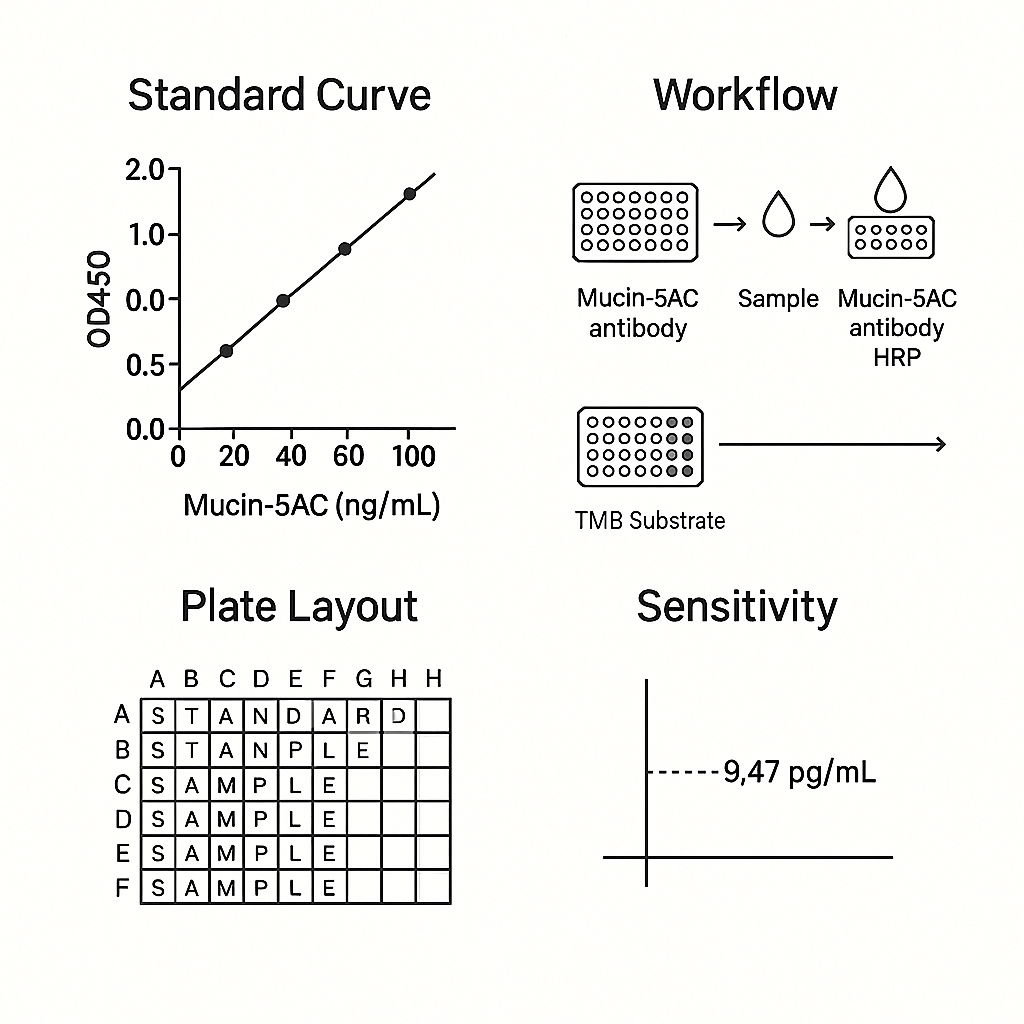
A sandwich ELISA uses a plate-bound capture antibody and a detection antibody recognizing a non-overlapping epitope. Signal is generated by HRP acting on TMB substrate, stopped with acid, and read at 450 nm (optional 540/570 nm reference).
-
TMB chemistry (NIH PubChem): https://pubchem.ncbi.nlm.nih.gov/
-
Spectrophotometry fundamentals (U-Michigan): https://www.umich.edu/
-
ELISA primers (MIT OCW): https://ocw.mit.edu/
SEO tip: include phrases like Mucin-5AC ELISA kit, MUC5AC sandwich ELISA, HRP-TMB 450 nm, 4PL standard curve, glycoprotein quantification.
Sample Types and Pre-Analytics (Research Context)
Matrices: conditioned media, buffer-extracted mucosal secretions, and compatible cell lysates.
Key factors: viscosity, glycan density, protease activity, and detergents can influence recovery.
-
General lab safety and SOP thinking (CDC Labs): https://www.cdc.gov/lab/
-
Chemical hygiene & PPE (OSHA Laboratory): https://www.osha.gov/laboratory
-
Waste handling overview (EPA): https://www.epa.gov/hwgenerators
-
Pipetting assurance & calibration (NIST programs): https://www.nist.gov/programs-projects
Practical tips
-
Use mild non-ionic detergents to solubilize high-MW mucins while preserving epitopes.
-
Keep freeze/thaw cycles to a minimum.
-
Add protease inhibitors fresh.
-
Pre-clear turbid samples by low-g spin to reduce non-specific adsorption.
Reagents and Materials
-
High-binding 96-well microplates (flat bottom).
-
Capture/detection monoclonal antibodies validated against non-overlapping MUC5AC regions.
-
HRP conjugate (direct or streptavidin-HRP if biotinylated secondary is used).
-
TMB substrate, acid stop, wash buffer (PBS or TBS + 0.05% Tween-20), sample diluent.
-
Plate sealer, calibrated pipettes, plate washer or manual wash setup.
-
Plate reader, OD 450 nm capability (validate linearity with NIST-traceable references).
Suggested Protocol (Concise, Reproducible)
-
Equilibrate all reagents to room temperature (RT).
-
Standards: prepare a 2× or 3× serial dilution covering expected range.
-
Add 100 µL of standards and samples; incubate 2 h at 37 °C; wash 3×.
-
Add 100 µL detection antibody (1×); incubate 1 h at 37 °C; wash 3×.
-
Add 100 µL HRP conjugate; incubate 1 h at 37 °C; wash 5×.
-
Add 100 µL TMB; develop 15–20 min in the dark.
-
Add 50 µL stop solution; read at 450 nm within 5 min (optional 540/570 nm reference).
Technique refreshers
-
Stanford methods pages: https://www.stanford.edu/
-
UCSF research resources: https://www.ucsf.edu/
-
University of Arizona biochemistry labs: https://www.arizona.edu/
Controls and Acceptance Criteria
Include: Blank, Zero Standard, and Low/Mid/High QCs.
Typical research targets: intra-assay CV ≤ 10–15%, inter-assay CV ≤ 15–20%.
Perform spike-recovery (80–120% goal) and dilution linearity (80–120% across 2–3 dilutions).
Check plate uniformity and edge effects via layout design (see NIH Assay Guidance Manual: https://www.ncbi.nlm.nih.gov/books/NBK53196/).
Calibration, Curve Fitting, and Reporting
-
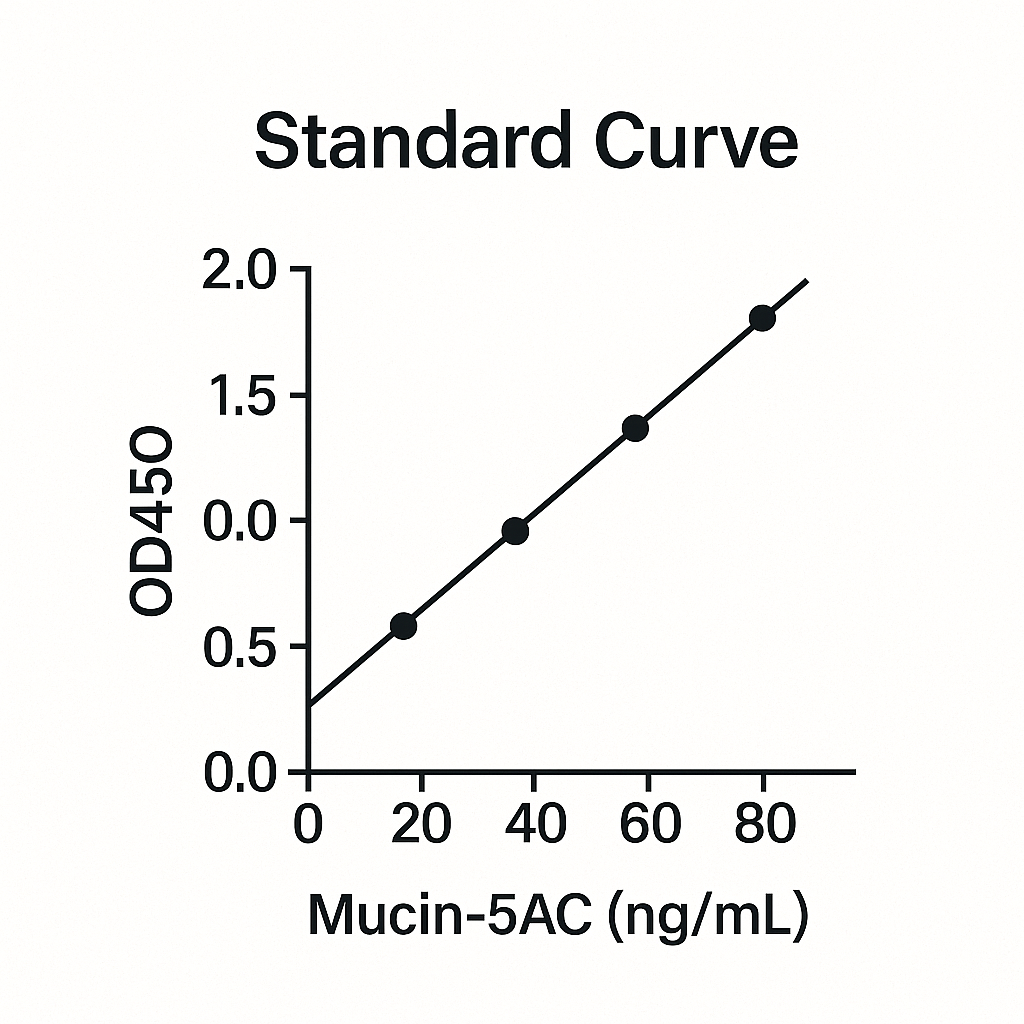
Fit 4-parameter logistic (4PL) or 5PL; document weighting (e.g., 1/y²).
-
Report LLOQ/ULOQ, back-calculated %Recovery for standards and QCs, and CV%.
-
Confirm reader performance against optical references (see NIST SRM: https://www.nist.gov/srm).
-
Keep raw OD tables and fit parameters for reproducibility (NLM/NIGMS guidance):
-
NLM data resources: https://www.nlm.nih.gov/
-
NIGMS reproducibility: https://www.nigms.nih.gov/
-
Specificity, Cross-Reactivity, and Interference
-
Test against MUC5B and other gel-forming mucins to validate specificity (compare gene entries on NCBI: https://www.ncbi.nlm.nih.gov/gene/).
-
Assess biotin interference when using streptavidin-HRP.
-
Evaluate detergent and salt effects on epitope exposure.
-
Consider heterophilic antibody blockers as needed.
-
Validate matrix effects with recovery and parallelism studies.
Troubleshooting (Symptom → Likely Cause → Corrective Action)
-
Low signal: suboptimal antibody pairing, short incubations, or expired TMB → verify clones, extend time, confirm TMB quality (PubChem: https://pubchem.ncbi.nlm.nih.gov/).
-
High background: insufficient washing or contaminated substrate → increase wash cycles/soak; use fresh TMB.
-
Non-parallelism: matrix viscosity or interference → dilute matrix; optimize diluent composition.
-
Poor precision: pipetting drift → recalibrate pipettes; review technique (NIST programs: https://www.nist.gov/programs-projects).
-
Edge effects: plate temperature gradients → equilibrate plates; seal during incubations.
Data Visualization and Record-Keeping
-
Use 4PL/5PL plots with residuals.
-
Include goodness-of-fit metrics and QC acceptance overlays.
-
Archive raw files plus method notes.
-
For basic image quant or figure prep, see ImageJ/Fiji: https://imagej.nih.gov/ij/.
Safety, Handling, and Waste (General)
-
Follow institutional SOPs for chemical handling and microplate disposal.
-
OSHA lab safety: https://www.osha.gov/laboratory
-
CDC lab guidance: https://www.cdc.gov/lab/
-
EPA waste basics: https://www.epa.gov/hwgenerators
Learning and Teaching References (Non-Clinical)
-
MIT OCW lab modules: https://ocw.mit.edu/
-
U-Wisconsin research/teaching: https://www.wisc.edu/
-
Harvard academic resources: https://www.harvard.edu/
-
U-Washington instrumentation basics: https://www.washington.edu/
SEO Playbook for Your Product Page
Primary keyword focus:
Mucin-5AC ELISA, MUC5AC ELISA kit, MUC5AC sandwich ELISA, glycoprotein quantification, HRP-TMB 450 nm, 4PL standard curve, high-molecular-weight mucin, O-glycosylation, microplate assay, research use only.
Title tag (≤60–65 chars):
Mucin-5AC (MUC5AC) ELISA | High-Specificity Research Assay
Meta description (≤155–160 chars):
Research-only Mucin-5AC ELISA. Robust 4PL quantification, HRP-TMB 450 nm, validated controls, clear SOPs, and reproducible performance.
H1/H2 ideas:
-
H1: Mucin-5AC (MUC5AC) ELISA — Research-Grade Quantification
-
H2: Assay Principle and Optimized Workflow
-
H2: Controls, 4PL Calibration, and Acceptance Criteria
-
H2: Troubleshooting and Data Integrity
Internal linking suggestions:
-
Link to ELISA buffers, microplate readers, plate washers, and protein standards categories.
-
Link to broader mucin biology and glycobiology resource pages.
-
Add a “Related Products” section (e.g., MUC5B ELISA, mucin extraction buffers, glycan-friendly detergents).
Image alt text templates:
-
alt="Mucin-5AC ELISA standard curve 4PL at 450 nm" -
alt="MUC5AC sandwich ELISA workflow with HRP-TMB detection" -
alt="ELISA plate map for MUC5AC quantification with QCs"
FAQ (non-clinical, crawlable):
-
What is the recommended dynamic range for MUC5AC standards?
A: Choose a range that brackets expected concentrations with ≥6 points for 4PL/5PL modeling. -
How do I reduce viscosity-related interference?
A: Increase sample dilution and optimize mild detergents to preserve epitopes. -
Which curve model fits best?
A: Start with 4PL; evaluate 5PL if asymmetry improves residuals and QC performance.