Introduction: What Are Multiplex Oligos and Why Are They Essential for Illumina Sequencing?
Next-generation sequencing (NGS) technologies have revolutionized the field of genomics, enabling high-throughput sequencing of DNA and RNA at an unprecedented scale. One of the most powerful features of these technologies is multiplexing — the ability to sequence multiple samples simultaneously in a single sequencing run. This is made possible by the use of multiplex oligonucleotides, or multiplex oligos, which are essential components in the library preparation process.
Multiplex Oligos Set 5 for Illumina is a prime example of a tool designed to streamline sequencing workflows while improving data throughput. It includes a set of dual-index primers that allow researchers to assign unique identifiers (barcodes) to multiple samples, enabling their pooled sequencing in a single run. The use of multiplex oligos significantly reduces sequencing costs per sample and increases the overall sequencing efficiency.
This article delves into the features, applications, and technical advantages of Multiplex Oligos Set 5, while optimizing the content for search engines with relevant keywords like multiplex sequencing, Illumina sequencing, dual-index primers, next-generation sequencing library prep, and more.

What Are Multiplex Oligos?
Multiplex oligonucleotides are short synthetic DNA sequences used to facilitate the identification and differentiation of individual samples in a pooled sequencing run. These oligos serve as index primers during the PCR amplification process in library preparation. They are designed to bind to specific regions of the Illumina adapters that are ligated to the DNA fragments during library preparation. The unique barcode sequences (indexes) attached to each sample allow researchers to pool several samples in a single sequencing run. After sequencing, the data can be demultiplexed to assign reads back to their respective samples, even when they were pooled together.
Key Features of Multiplex Oligos:
-
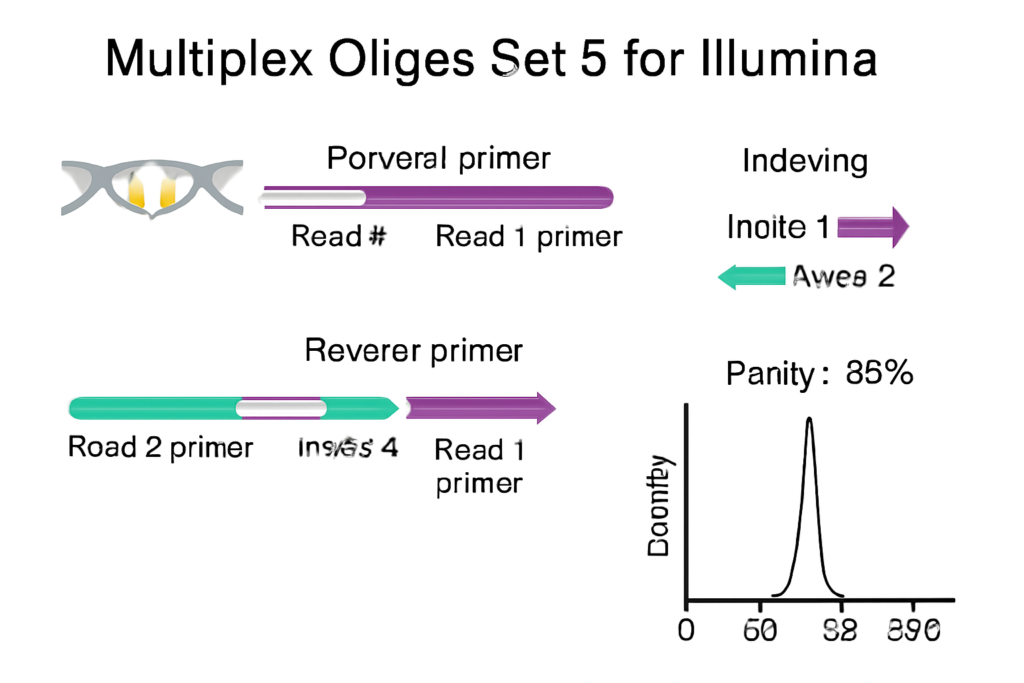
Dual Indexing: Multiplex Oligos Set 5 provides dual index primers (i5 and i7) that are essential for reducing index hopping and improving the accuracy of sample identification.
-
Flexibility and Compatibility: These oligos are compatible with a wide range of Illumina sequencing platforms, including MiSeq, NextSeq, HiSeq, and NovaSeq.
-
Reduced Costs: By multiplexing multiple samples into a single sequencing run, this set helps maximize sequencing throughput and reduce per-sample costs.
-
High Precision: The unique dual index combinations provided in Set 5 ensure that each sample is accurately tracked during sequencing, even in highly multiplexed experiments.
How Multiplex Oligos Set 5 for Illumina Enhances Sequencing Efficiency
Multiplexing is a crucial technique for modern genomics research. By using multiplex oligos to tag different samples with unique barcode sequences, researchers can pool them together, significantly increasing sequencing capacity and reducing time and costs. Multiplex Oligos Set 5 takes this efficiency to the next level by providing 96 unique dual-index combinations, allowing you to pool up to 96 samples in a single sequencing run.
Why Choose Set 5 for Illumina?
Multiplex Oligos Set 5 stands out for its ease of use, high compatibility with standard Illumina library preparation kits, and its ability to deliver high-quality, reproducible sequencing results. Below are some of the key features that make it a preferred choice for researchers:
-
96 Unique Index Combinations: Set 5 offers a range of index pairs (i5 and i7), allowing up to 96 different samples to be processed simultaneously. This capacity makes it an ideal solution for large-scale genomic projects that require pooling of multiple libraries.
-
Dual-Indexing Strategy: By using two different indexes (i5 and i7), Set 5 minimizes the risk of index misassignment, a common issue in single-indexing systems. Dual indexing helps ensure that each read is accurately associated with its corresponding sample.
-
Compatibility with Illumina Sequencing Platforms: Multiplex Oligos Set 5 is specifically designed for compatibility with Illumina’s next-generation sequencing (NGS) platforms. This includes popular platforms like MiSeq, NextSeq, and NovaSeq, which are commonly used in genomics labs for a wide variety of applications.
-
Cost-Effective Solution: The ability to multiplex up to 96 samples in a single run reduces the overall cost per sample, making high-throughput sequencing more affordable and accessible for research labs. This is particularly important in clinical genomics, population studies, and metagenomics where large numbers of samples need to be analyzed.
The Role of Dual-Index Primers in Illumina Sequencing
Dual-indexing is a key feature of modern sequencing workflows. It involves adding two unique index sequences to each sample: one to the 5′ adapter (i5) and one to the 3′ adapter (i7). This dual indexing strategy provides several key advantages over single indexing:
Reduces Index Hopping:
Index hopping, also known as barcode misassignment, occurs when reads from one sample are mistakenly assigned to another due to contamination or errors in the sequencing process. Dual indexing significantly reduces the risk of index hopping, improving the accuracy of demultiplexing.
Improved Sample Differentiation:
With dual indexes, the probability of two samples sharing the same index combination (which could lead to data misinterpretation) is minimized. This improves the overall reliability of the sequencing data.
Enables High-Throughput Analysis:
Dual indexing increases the multiplexing capacity of Illumina sequencing platforms, allowing researchers to pool hundreds or even thousands of samples in a single sequencing run. This is particularly useful for large-scale projects, such as genome-wide association studies (GWAS), transcriptomics, and microbiome sequencing.
Optimized for Illumina Technology:
Multiplex Oligos Set 5 is tailored for Illumina’s sequencing by synthesis (SBS) technology, making it an ideal choice for those using Illumina sequencers for their research. The unique dual-index primer pairs in this set are optimized to work seamlessly with Illumina’s library prep kits, ensuring accurate and reproducible sequencing results.
Applications of Multiplex Oligos Set 5 in Genomics Research
Multiplex Oligos Set 5 is a versatile tool for a wide range of genomic research applications, including but not limited to:
Whole Genome Sequencing (WGS)
Multiplex Oligos Set 5 is commonly used in whole genome sequencing (WGS) projects, where high-throughput sequencing of large numbers of samples is required. Researchers use this oligo set to pool samples together and sequence them in a single run, dramatically increasing the efficiency and cost-effectiveness of WGS experiments.
Transcriptome Analysis (RNA-Seq)
In RNA sequencing (RNA-Seq), multiplexing allows researchers to compare the gene expression profiles of multiple samples in parallel. This is particularly useful for differential expression analysis, single-cell RNA-Seq, and quantifying gene expression across different conditions, tissues, or disease states.
Targeted Sequencing and Amplicon Sequencing
Multiplex Oligos Set 5 is also widely used in targeted sequencing applications, such as exome sequencing, amplicon sequencing, and CRISPR screening. These approaches enable researchers to focus on specific regions of the genome while still benefiting from the high throughput enabled by multiplexing.
Metagenomics
In metagenomic sequencing, where multiple species are present in a single sample (e.g., gut microbiome, environmental samples), multiplex indexing is essential for differentiating between individual species or strains. Multiplex Oligos Set 5 makes it easier to analyze complex microbial communities, enabling researchers to sequence multiple samples simultaneously.
Epigenetics and ChIP-Seq
ChIP-Seq (Chromatin Immunoprecipitation Sequencing) and other epigenetic studies benefit from multiplexing to assess modifications such as DNA methylation, histone modifications, and transcription factor binding. Multiplex Oligos Set 5 enables the sequencing of multiple epigenetic profiles in parallel.
Best Practices for Using Multiplex Oligos Set 5
To achieve optimal results with Multiplex Oligos Set 5 for Illumina, researchers should follow best practices in their NGS workflows. These include:
Accurate Library Quantification
Accurate quantification of each library before pooling is essential to ensure that all samples are equally represented in the sequencing run. Use methods such as Qubit, Bioanalyzer, or qPCR for accurate library quantification.
Avoiding Index Collisions
While Multiplex Oligos Set 5 provides 96 unique dual index pairs, it is important to carefully plan sample barcoding to avoid index collisions (where two different samples receive the same index combination). Consider pooling multiple sets of multiplex oligos to expand the available index combinations for larger projects.
Quality Control of Prepared Libraries
Perform quality control checks on the final library, including fragment size analysis and concentration measurements, to ensure the libraries are of high quality and suitable for sequencing.
Sequencing on Appropriate Illumina Platforms
Multiplex Oligos Set 5 is compatible with a variety of Illumina sequencers. Ensure that your chosen sequencing platform supports the level of multiplexing required for your experiment. Platforms such as MiSeq, NextSeq, and NovaSeq provide flexible options for different throughput needs.
Conclusion: Unlocking the Power of Multiplexing with Multiplex Oligos Set 5 for Illumina
Multiplex Oligos Set 5 for Illumina is an indispensable tool for researchers aiming to optimize their NGS workflows, reduce costs, and increase throughput. By offering dual-indexing capabilities, high compatibility with Illumina platforms, and robust multiplexing capacity, Set 5 enables efficient and accurate sequencing across a range of genomic applications, from whole genome sequencing to metagenomics and targeted sequencing.
Whether you’re conducting high-throughput experiments or working with limited sample quantities, Multiplex Oligos Set 5 provides a scalable, flexible, and cost-effective solution for modern genomics research.